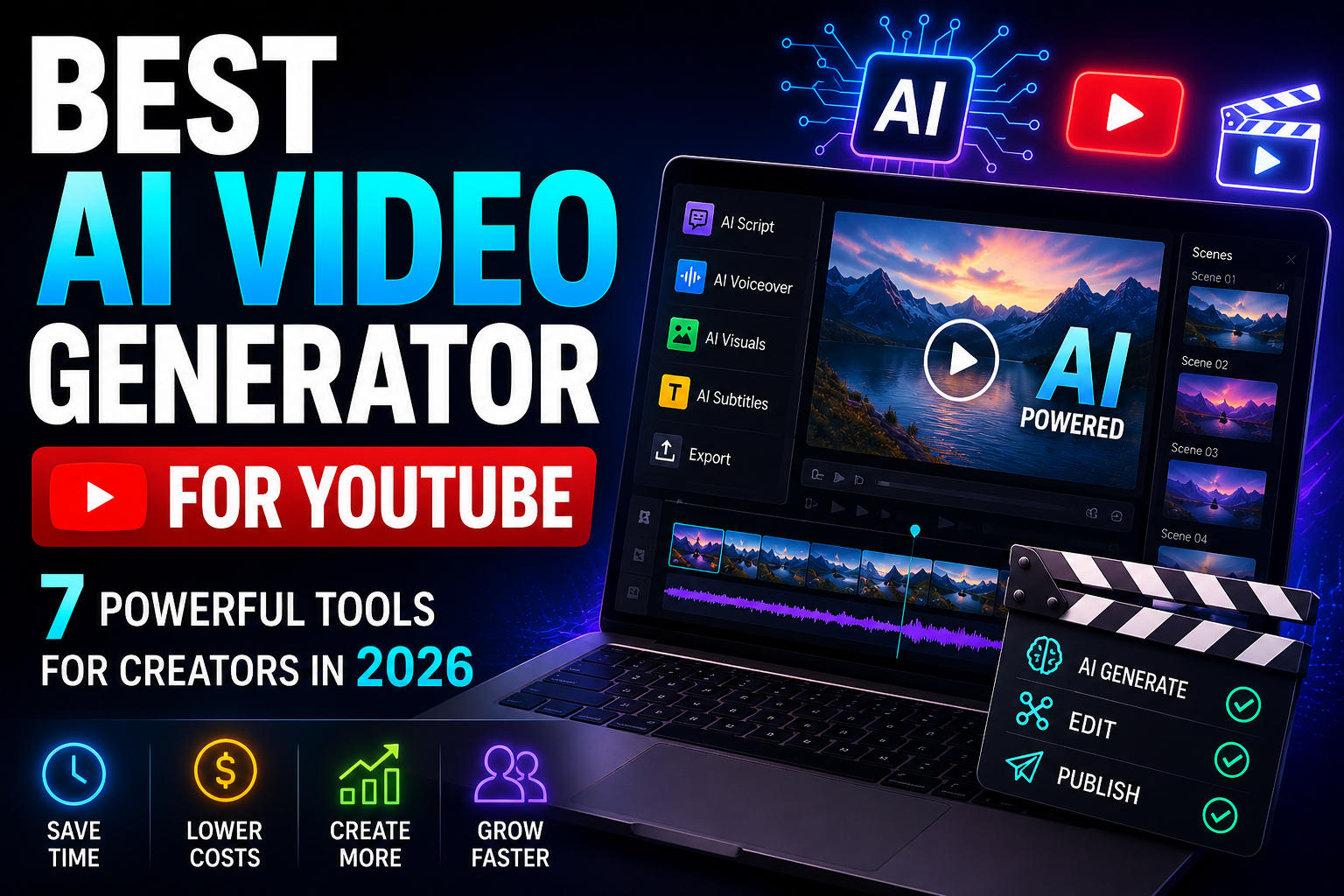
Best AI Video Generator for YouTube: 7 Powerful Tools Every Creator Should Try in 2025

If you’re searching for the best AI video generator for YouTube, you’re in the right place. AI-powered video creation tools have completely changed how creators produce content. Instead of spending hours recording, editing, and creating visuals, you can now generate professional videos in minutes using artificial intelligence.

Whether you’re running a faceless YouTube channel, creating educational content, posting YouTube Shorts, or building a YouTube automation business, choosing the right AI video generator for YouTube can help you create more content in less time.

In this guide, we’ll explore the top AI video generators available today, compare their features, and help you choose the best solution for your channel.

Looking for free AI video generators? Don’t worry. We’ve listed the best free tools at the bottom of this article.


What Is an AI Video Generator for YouTube?

An AI video generator for YouTube is a tool that uses artificial intelligence to create videos from text prompts, scripts, blog posts, images, or simple instructions.

Most modern AI video generators can:

  • Generate video scenes automatically
  • Create AI voiceovers
  • Add captions and subtitles
  • Convert text into videos
  • Suggest stock footage
  • Generate scripts
  • Produce YouTube Shorts
  • Create faceless YouTube videos

This allows creators to focus on ideas and content rather than spending countless hours editing.


Why Use an AI Video Generator for YouTube?

The popularity of AI tools continues to grow because they solve some of the biggest challenges creators face.

Save Time

What once took several hours can now be completed within minutes.

Reduce Production Costs

Many creators no longer need expensive cameras, microphones, or editing teams.

Scale Content Production

An AI video generator for YouTube makes it possible to publish more videos consistently.

Create Faceless Channels

Many successful YouTube channels now operate entirely without showing the creator’s face.

Improve Video Quality

Modern AI tools offer professional-quality visuals, voiceovers, and animations.


Best AI Video Generator for YouTube: Top 7 Tools

1. InVideo AI

InVideo AI has quickly become one of the most popular choices for creators looking for an AI video generator for YouTube.

The platform allows users to describe a video idea using a simple prompt. The AI then generates a complete video including visuals, script suggestions, voiceovers, transitions, and captions.

Key Features

  • Text-to-video generation
  • AI voiceovers
  • Automated video creation
  • Millions of stock assets
  • YouTube-ready templates

Best For

  • Faceless YouTube channels
  • YouTube automation businesses
  • Marketing videos
  • Educational content

Pros

  • Extremely beginner friendly
  • Fast content generation
  • Large media library

Cons

  • Advanced creators may want more customization options

2. Pictory

Pictory is an excellent AI video generator for YouTube creators who already have written content.

One of its strongest features is the ability to transform blog posts into engaging videos. This makes it especially useful for bloggers and affiliate marketers.

Key Features

  • Blog-to-video conversion
  • AI summarization
  • Automatic captions
  • Voiceovers
  • Stock video integration

Best For

  • Bloggers
  • Tech websites
  • News channels
  • Affiliate marketers

Pros

  • Converts existing content into videos
  • Easy workflow
  • Excellent caption generation

Cons

  • Limited advanced editing capabilities

3. Synthesia

Synthesia is widely known for its realistic AI avatars.

Instead of filming yourself, you can simply type a script and choose an AI presenter who delivers your message professionally.

Key Features

  • AI avatars
  • Multiple languages
  • Text-to-video creation
  • Professional templates
  • Custom branding

Best For

  • Tutorials
  • Corporate content
  • Educational videos
  • Product demonstrations

Pros

  • No camera required
  • Professional appearance
  • Supports global audiences

Cons

  • Less creative freedom compared to traditional video editing

4. Runway

Runway is one of the most advanced AI video platforms currently available.

Creators can generate videos from text prompts, animate images, and perform advanced editing using AI-powered tools.

Key Features

  • Text-to-video generation
  • Image-to-video conversion
  • AI editing tools
  • Motion tracking
  • Advanced visual effects

Best For

  • Creative creators
  • Filmmakers
  • Visual storytellers

Pros

  • Cutting-edge technology
  • High-quality output
  • Powerful editing capabilities

Cons

  • Requires some learning

5. VEED

VEED combines video editing and artificial intelligence in a single platform.

It is particularly popular among YouTube creators who regularly publish tutorials, podcasts, interviews, and educational content.

Key Features

  • AI subtitles
  • AI voiceovers
  • Online video editor
  • Text-to-video generation
  • Screen recording

Best For

  • Tutorials
  • Educational channels
  • Business content

Pros

  • Easy-to-use interface
  • Browser-based editor
  • Fast subtitle generation

Cons

  • Some advanced features require premium plans

6. HeyGen

HeyGen specializes in realistic AI presenters and avatar videos.

It allows creators to generate professional spokesperson videos without hiring actors or recording footage.

Key Features

  • AI avatars
  • Voice cloning
  • Multi-language support
  • Text-to-video generation

Best For

  • Business channels
  • Explainer videos
  • Product reviews

Pros

  • Realistic avatar quality
  • Professional results
  • Fast video creation

Cons

  • Limited creative storytelling features

7. Lumen5

Lumen5 is designed for content marketers and bloggers who want to repurpose written content into video format.

The platform automatically transforms articles into engaging videos suitable for YouTube and social media.

Key Features

  • Blog-to-video conversion
  • Drag-and-drop editor
  • AI scene creation
  • Built-in media library

Best For

  • Bloggers
  • Affiliate marketers
  • Small businesses

Pros

  • Easy content repurposing
  • Beginner-friendly interface
  • Fast workflow

Cons

  • Limited advanced editing options

Best AI Video Generator for YouTube for Beginners

If you’re completely new to AI video creation, these tools offer the easiest learning curve:

  1. InVideo AI
  2. Pictory
  3. VEED
  4. Canva AI Video

These platforms require little technical knowledge and can produce professional results quickly.


Best AI Video Generator for YouTube for Faceless Channels

Faceless channels continue to dominate niches such as:

  • Technology
  • Finance
  • Motivation
  • History
  • Celebrity news
  • AI tutorials

For these channels, the best AI video generators are:

  • InVideo AI
  • Pictory
  • Synthesia
  • HeyGen

These tools make it possible to create videos without recording yourself.


Free AI Video Generator for YouTube Creators

Many creators want to test AI tools before purchasing a subscription.

Here are some of the best free options available today.

CapCut

CapCut offers powerful AI features including auto-captions, AI editing, and video enhancements.

Canva AI Video

Canva combines design tools with AI-powered video creation features and is perfect for beginners.

Clipchamp

Microsoft’s Clipchamp provides free editing tools with basic AI capabilities.

VEED Free Plan

VEED allows users to create and edit videos using its free tier.

InVideo Free Plan

InVideo offers a free plan that lets creators explore AI video generation before upgrading.


How to Choose the Best AI Video Generator for YouTube

Before choosing a platform, ask yourself:

  • Do you need AI avatars?
  • Are you creating faceless content?
  • Do you want text-to-video generation?
  • Is your budget limited?
  • Do you need advanced editing tools?

For most creators, InVideo AI offers the best balance between simplicity, features, and affordability.

However, creators focused on avatar videos may prefer Synthesia or HeyGen, while advanced users may find Runway more powerful.


FAQ

What is the best AI video generator for YouTube?

InVideo AI, Pictory, and Synthesia are currently among the most popular choices for YouTube creators.

Is there a free AI video generator for YouTube?

Yes. CapCut, Canva AI, Clipchamp, VEED, and InVideo all offer free plans with AI-powered features.

Can AI create YouTube videos automatically?

Yes. Modern AI video generators can create scripts, visuals, voiceovers, subtitles, and complete videos from simple text prompts.

Which AI video generator is best for faceless YouTube channels?

Pictory, InVideo AI, HeyGen, and Synthesia are excellent options for faceless content creators.


Final Verdict

The best AI video generator for YouTube ultimately depends on your content style and goals. If you’re looking for an all-around solution, InVideo AI stands out as one of the strongest options available today. Meanwhile, Pictory excels at transforming written content into videos, and Synthesia leads the market for AI avatars.

No matter which platform you choose, AI video creation can dramatically increase productivity, reduce production costs, and help you grow your YouTube channel faster than ever before.

If you’re just getting started, don’t forget to check out the free AI video generators listed above before investing in a paid subscription.

Claude Just Changed the Economics of Enterprise AI

Artificial intelligence has moved beyond experimentation and become a critical business investment. Organizations across industries are racing to integrate AI into their operations, customer service, software development, data analysis, and decision-making processes. However, one challenge has consistently slowed enterprise adoption: cost.

That equation is now changing, largely because of Claude AI.

Developed by Anthropic, Claude AI is emerging as one of the most influential AI platforms in the enterprise market. While many discussions focus on model performance, reasoning capabilities, and benchmark scores, the real story is economic. Claude AI is reshaping how businesses calculate the return on investment from artificial intelligence.

The result is a significant shift in the economics of enterprise AI.

Why Enterprise AI Economics Matter

For years, organizations viewed AI as a promising but expensive technology. Companies often faced challenges such as:

  • High implementation costs
  • Expensive infrastructure requirements
  • Significant training and deployment expenses
  • Limited scalability
  • Uncertain return on investment

Many AI initiatives started with enthusiasm but struggled to demonstrate measurable business value.

Enterprise leaders increasingly ask a simple question:

Can AI generate more value than it costs?

Claude AI is helping organizations answer that question with greater confidence.

Claude AI Reduces Operational Costs

One of the biggest advantages of Claude AI is its ability to automate knowledge-intensive work.

Traditional automation focused on repetitive tasks. Claude AI extends automation into areas that previously required human expertise, including:

  • Document analysis
  • Contract review
  • Research synthesis
  • Customer support
  • Internal knowledge management
  • Content generation
  • Technical documentation

Instead of hiring additional personnel to handle growing workloads, companies can leverage Claude AI to complete substantial portions of these tasks faster and more efficiently.

This reduction in labor-intensive processes directly impacts operational costs, making enterprise AI adoption financially attractive.

Higher Productivity Across Teams

Productivity gains are often the largest source of AI-driven value.

Claude AI enables employees to spend less time on routine activities and more time on strategic work. Teams can use Claude AI to:

  • Summarize lengthy reports
  • Draft business communications
  • Generate code
  • Analyze large datasets
  • Create presentations
  • Develop marketing content

What previously required several hours can often be completed in minutes.

For enterprises employing thousands of workers, even modest productivity improvements can translate into millions of dollars in annual savings.

This shift fundamentally changes the economic calculation of AI implementation.

Enterprise-Grade Reliability Matters

Many businesses hesitate to deploy AI systems because of concerns about reliability and trustworthiness.

Claude AI has gained attention for its focus on safety, transparency, and enterprise readiness. Organizations require AI systems that can operate consistently across critical workflows.

When AI outputs are more reliable, companies spend less time reviewing, correcting, and validating results.

This creates a secondary economic benefit:

  • Reduced oversight costs
  • Faster workflow execution
  • Improved employee confidence
  • Greater adoption across departments

Reliable AI is not just a technical advantage; it is an economic advantage.

The Rise of AI-Powered Knowledge Workers

Knowledge work represents one of the largest expense categories in modern organizations.

Professionals spend significant portions of their day:

  • Searching for information
  • Writing reports
  • Reviewing documents
  • Answering questions
  • Managing internal communications

Claude AI acts as a digital knowledge assistant that can accelerate all of these activities.

Instead of replacing employees, the technology amplifies their capabilities.

A single employee supported by Claude AI can often accomplish substantially more work than before, increasing output without requiring proportional increases in headcount.

This creates a powerful leverage effect for enterprises seeking growth while controlling costs.

Better ROI From AI Investments

Historically, AI projects struggled because implementation costs exceeded measurable benefits.

Claude AI is changing that dynamic by making advanced AI capabilities more accessible and practical for everyday business use.

Organizations can deploy AI across multiple functions, including:

  • Human resources
  • Finance
  • Legal
  • Operations
  • Marketing
  • Customer support
  • Software development

Because value is generated across several departments simultaneously, the return on investment becomes easier to justify.

Instead of isolated AI experiments, businesses can create organization-wide efficiency gains.

Scalable AI Without Massive Infrastructure

Traditional enterprise AI initiatives often required extensive infrastructure investments.

Companies needed specialized hardware, machine learning engineers, and dedicated AI teams to deploy sophisticated solutions.

Claude AI simplifies adoption by providing powerful capabilities through accessible interfaces and integrations.

This lowers barriers to entry for organizations of all sizes.

Small and medium-sized businesses can now access enterprise-grade AI capabilities without building large internal AI departments.

The democratization of advanced AI is one of the most significant economic shifts in the technology sector.

Competitive Advantage Through Faster Decision-Making

Modern business environments reward speed.

Organizations that can gather information, analyze data, and make decisions faster often outperform competitors.

Claude AI helps accelerate decision-making by:

  • Summarizing research
  • Identifying trends
  • Generating insights
  • Organizing information
  • Supporting strategic planning

Faster decisions lead to faster execution.

In highly competitive industries, that speed advantage can translate directly into revenue growth and market share gains.

Enterprise AI Is Becoming a Utility

A major economic transformation occurs when technology evolves from a premium innovation into a business utility.

Cloud computing followed this path.

Internet connectivity followed this path.

Enterprise AI is beginning to follow the same trajectory.

Claude AI is helping move artificial intelligence from an experimental technology into an everyday business tool.

As adoption increases and organizations integrate AI into standard workflows, businesses will increasingly view AI not as an optional investment but as essential infrastructure.

This transition dramatically changes spending priorities and long-term technology strategies.

The Future of Enterprise AI Economics

The next phase of AI adoption will not be determined solely by which model performs best on benchmarks.

Instead, businesses will focus on outcomes:

  • Cost savings
  • Productivity improvements
  • Operational efficiency
  • Employee effectiveness
  • Revenue growth

Claude AI is positioned at the center of this shift because it aligns technological capability with business value.

Organizations no longer need to ask whether AI works.

The question is becoming how quickly they can deploy it across their operations.

Conclusion

Claude AI is doing more than improving artificial intelligence capabilities. It is transforming the financial logic behind enterprise AI adoption.

By reducing operational costs, increasing workforce productivity, supporting scalable deployments, and delivering measurable business value, Claude AI is changing how organizations evaluate technology investments.

The companies that understand this shift early will be better positioned to gain efficiency, accelerate growth, and compete in an increasingly AI-driven economy.

The economics of enterprise AI have changed, and Claude AI is one of the primary reasons why.

Google Bard vs ChatGPT: A Comparison of Two Powerful AI Chatbots

Google Bard vs ChatGPT: Which AI Chatbot is Right for You?

In recent years, artificial intelligence (AI) has made significant progress in the field of natural language processing (NLP). This has led to the development of powerful AI chatbots that can simulate human conversation. Two of the most popular AI chatbots are Google Bard and ChatGPT.

Google Bard

Google Bard is a large language model (LLM) developed by Google AI. It is trained on a massive dataset of text and code, which allows it to generate text, translate languages, write different kinds of creative content, and answer your questions in an informative way. Some of the features of Google Bard include:

  • Can generate text, translate languages, write different kinds of creative content, and answer your questions in an informative way.
  • Access to the internet in real time, which allows it to provide up-to-date information.
  • Can be used for a variety of tasks, such as customer service, education, and research.

ChatGPT

ChatGPT is an LLM developed by OpenAI. It is also trained on a massive dataset of text, but it is specifically designed to generate human-quality text. Some of the features of ChatGPT include:

  • Can generate human-quality text, such as poems, code, scripts, musical pieces, email, letters, etc.
  • Can be used for a variety of tasks, such as creative writing, content generation, and marketing.

So, which AI chatbot is right for you?

It depends on your needs. If you are looking for a chatbot that can provide information and answer your questions, then Google Bard is a good choice. If you are looking for a chatbot that can generate creative content, then ChatGPT is a better option.

Here is a table that summarizes the key differences between Google Bard and ChatGPT:

FeatureGoogle BardChatGPT
DeveloperGoogle AIOpenAI
Training dataText and codeText
CapabilitiesGenerate text, translate languages, write different kinds of creative content, answer questionsGenerate human-quality text
Best forInformation and question answeringCreative content generation

Ultimately, the best way to decide which AI chatbot is right for you is to try them both out. Both Google Bard and ChatGPT are available for free.

I hope this helps! Let me know if you have any other questions.

Unlock Your Creativity with Google Bard: An Introduction to AI Poetry and Creative Writing

Google Bard is a groundbreaking new AI tool developed by Google that can generate poetry and other forms of creative writing. It uses a combination of natural language processing, deep learning, and other advanced AI techniques to create poems that are almost indistinguishable from those written by humans. This tool has the potential to revolutionize the field of creative writing, giving writers and poets a powerful new tool for unlocking their creativity and exploring new ideas.

In this article, we will explore Google Bard in depth, looking at its features, capabilities, and limitations. We will also examine the potential implications of this tool for the field of AI and creative writing.

Features of Google Bard

Google Bard is designed to be a powerful and flexible tool for generating creative writing. Some of its key features include:

  1. Natural Language Processing

Google Bard uses advanced natural language processing algorithms to analyze the meaning and structure of language. This allows it to create poems that are not only grammatically correct but also convey a sense of emotion and depth. The tool can analyze the context and meaning of words and phrases, as well as the relationships between them.

  1. Deep Learning

Google Bard is powered by deep learning algorithms, which allow it to learn and improve over time. As more data is fed into the tool, it becomes better at generating poems that are both engaging and emotionally resonant. This means that Google Bard has the potential to continue improving and evolving in the future, becoming an even more powerful tool for creative writing.

  1. Customization Options

Google Bard includes a variety of customization options, allowing users to adjust the style, tone, and length of the poems they generate. This means that writers and poets can tailor the output of the tool to fit their specific needs and preferences. For example, they can choose to generate poems that are more formal or more casual, or that focus on specific themes or topics.

  1. Accessibility

One of the key advantages of Google Bard is its accessibility. The tool is designed to be user-friendly and accessible to anyone, regardless of their level of experience with AI or programming. Users simply input a few keywords or phrases, and Google Bard will generate a poem based on those inputs. This means that even novice writers and poets can use the tool to unlock their creativity and explore new ideas.

Capabilities of Google Bard

Google Bard is capable of generating poems on a wide range of topics, from love and nature to politics and social issues. The tool can also be used to generate song lyrics, speeches, and other forms of creative writing. Some of the key capabilities of Google Bard include:

  1. Emotional Resonance

One of the most impressive features of Google Bard is its ability to generate poems that are emotionally resonant. The tool can analyze the context and meaning of words and phrases, and use this information to create poems that convey a sense of emotion and depth. This means that the poems generated by Google Bard are not only grammatically correct, but also engaging and emotionally compelling.

  1. Originality

Another key capability of Google Bard is its ability to generate original poems. While the tool is based on a database of existing poems and language patterns, it is able to generate poems that are unique and original. This means that writers and poets can use the tool to explore new ideas and generate fresh, original content.

  1. Adaptability

Google Bard is designed to be adaptable and flexible, allowing writers and poets to customize the output of the tool to fit their specific needs and preferences. The tool can be used to generate poems of different lengths and styles, as well as poems on different topics and themes. This means that writers and poets can use the tool to explore a wide range of creative ideas and possibilities.

Limitations of Google Bard

While Google Bard is an impressive and powerful tool, it is not without its limitations.

artificial intelligence to get new feature on Self supervised learning ?

Self-supervised learning is one of those ongoing ML strategies that have caused a gradually expanding influence in the information science to organize, yet have so far been flying under the radar to the degree Entrepreneurs and Fortunes of the world go; the general populace is yet to get some answers concerning the thought at this point bunches of AI society think of it as dynamic. The worldview holds massive potential for endeavors too as it can help handle profound learning’s most overpowering issue: information/test wastefulness and resulting exorbitant preparation.

Yann LeCun said that if the information was a cake, unaided learning would be the cake, directed learning would be what tops off an already good thing and support learning would be the cherry on the cake. We understand how to make the icing and the cherry, nonetheless, we haven’t the foggiest how to make the cake.”

Unaided learning won’t progress a great deal and said there is a monstrous applied to detach concerning how correctly it should work and that it was the dull issue of AI. That is, we confide in it to exist, yet we don’t have the foggiest thought of how to see it.

Progress in solo learning will be slow, in any case, it will be generally dictated by meta-learning calculations. Deplorably, the articulation “Meta-Learning” had become the catch-all statement of the calculation that we didn’t perceive how to make. Regardless, meta-learning and unaided learning are associated in an incredibly straightforward way that I might want to look at in progressively noticeable detail later on.

There is something in a general sense defective with our cognizance of the upsides of UL. An adjustment in the setting would be required. The conventional structure (for instance grouping and dividing) of UL is, in reality, a basic undertaking. This is an immediate consequence of its detachment (or decoupling) from the downstream wellness, goal, or target work. Regardless, ongoing achievement in the NLP space with ELMO, BERT, and GPT-2 to remove novel structures staying in the measurements of normal language has prompted colossal upgrades in various downstream NLP errands that utilization these embeddings.

To have a powerful UL induced implanting, one can use existing priors that artfulness out the verifiable connections that can be found in information. These unaided learning strategies make new NLP embeddings that make unequivocal the relationship that is inborn in characteristic language.

Self-administered learning is one of a couple of proposed plans to make information productive man-made brainpower frameworks. Presently, it’s amazingly hard to anticipate which framework will win concerning making the following AI transformation (on the off chance that we’ll end up getting an astonishing method). Nonetheless, this is our opinion of LeCun’s masterplan.

What is habitually insinuated as the confinements of profound learning seem to be, believe it or not, an imperative of managed learning? Directed learning is the class of AI calculations that require commented on preparing information. For instance, on the off chance that you have to make a picture arrangement model, you ought to set it up on incalculable pictures that have been set apart with their genuine class.

Profound learning can be applied to different learning perfect models, LeCun included, including regulated learning, fortification learning, just as solo or self-administered learning.

However, the confusion incorporating profound learning and administered learning isn’t without reason. For the occasion, a large portion of the profound learning calculations that have found their way into down to earth applications relies upon regulated learning models, which says a ton in regards to the current shortcomings of AI structures. Picture classifiers, facial acknowledgment frameworks, discourse acknowledgment frameworks, and a considerable lot of the other AI applications we use every day have been prepared on countless marked models.

Using managed learning, information researchers can get machines to perform extraordinarily well on certain mind-boggling assignments, for instance, picture grouping. Nonetheless, the achievement of these models is predicated for huge scope named datasets, which makes issues in the districts where first-class data is uncommon. Marking countless information objects is expensive, time-concentrated, and unfeasible as a rule.

Oneself directed learning worldview, which attempts to get the machines to get supervision signals from the data itself (without human incorporation) might be the reaction to the issue. As shown by a portion of the main AI scientists, it can improve systems strength, vulnerability estimation capacity, and decrease the expenses of model preparing in AI.

One of the key favorable circumstances of self-directed learning is the huge increment in the measure of information yielded by the AI. In support of picking up, preparing the AI framework is performed at the scalar level; the model gets a solitary numerical incentive as compensation or discipline for its exercises. In administered learning, the AI structure predicts a class or a numerical motivation for every data. In self-regulated learning, the yield improves to a whole picture or set of pictures. “It’s altogether more information. To get comfortable with a comparative measure of information about the world, you will require fewer models,” LeCun says.